
Speech therapist in Greater Noida — Dr. Manish Sinha
Dr. Manish Sinha, RCI registered speech-language pathologist and ISHA member, has run this Pari Chowk speech therapy centre in Greater Noida for over twenty years. Parents rate it among the best for speech delay, late talking, articulation and phonological disorder, apraxia, language disorder, stammering, autism, ADHD, developmental delay, Down syndrome and cerebral palsy. Speech, occupational, ABA, CBT, special education and hearing aid therapies sit under one roof. Every child is assessed on standardised tools such as ADOS-2, CELF, PLS and VB-MAPP before therapy begins, so you leave with a written plan and measurable goals.
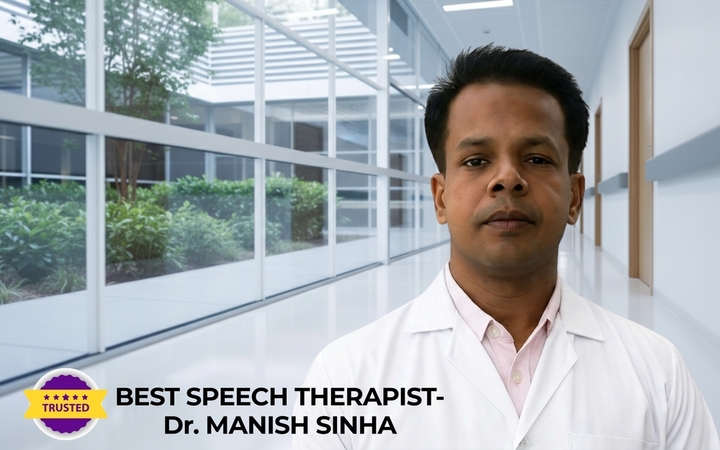
The practice at a glance
20+ years
Paediatric clinical practice
RCI registered
Statutory registration required to practise in India
ISHA member
Indian Speech and Hearing Association
One clinic
Pari Chowk, Greater Noida — no branches
Therapies available in Greater Noida
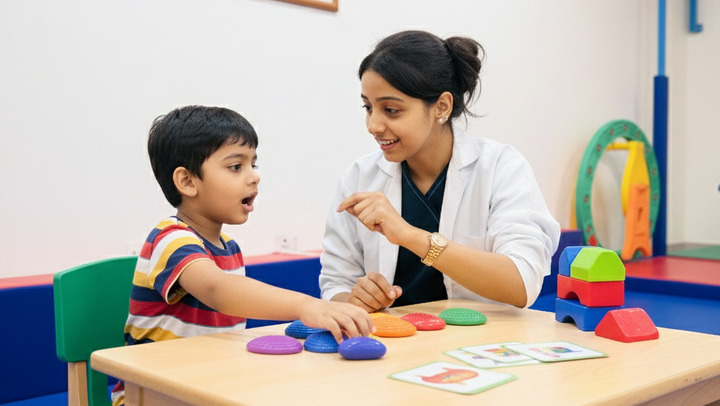
Speech and language therapy
One-to-one work on first words, vocabulary, sentence building, comprehension, speech sound accuracy, motor speech planning and fluency. Plans start from CELF and PLS baselines and are re-measured at review. Detail on method is set out under speech therapy.
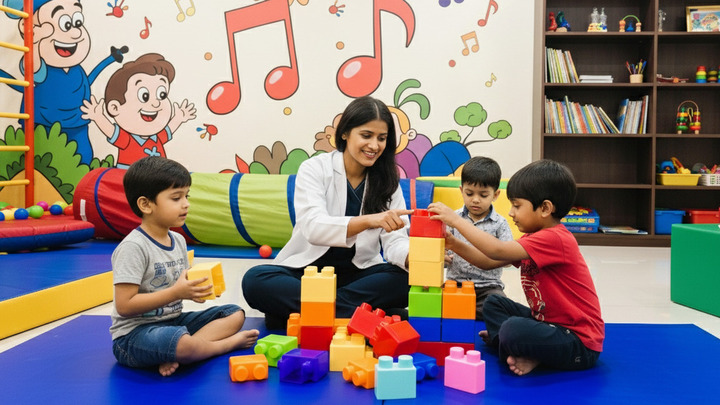
Autism assessment and intervention
ADOS-2 informed assessment, then a communication-first programme covering requesting, joint attention, play and social interaction, with sensory and behavioural support layered in. Families can read the full programme description under autism therapy.
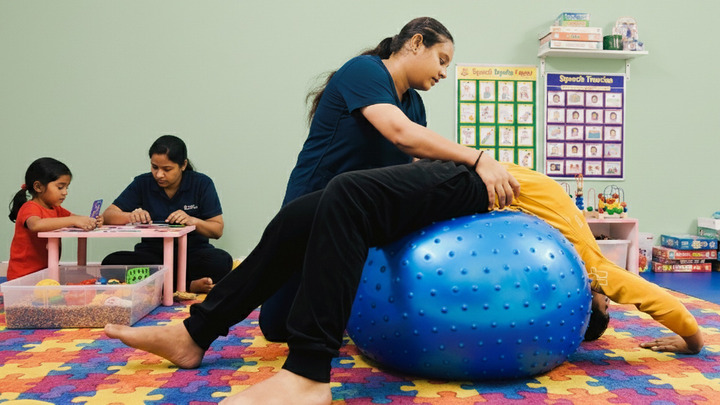
Occupational therapy
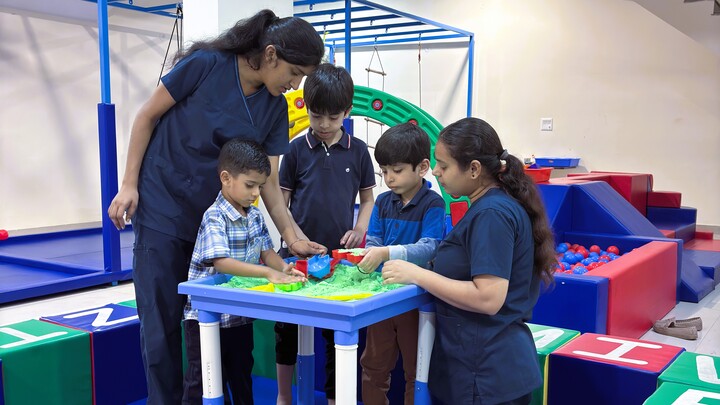
Sensory integration, postural control, fine and gross motor skills, handwriting and self-care, delivered in an equipped sensory gym and guided by Sensory Profile findings. Programme details appear under occupational therapy.
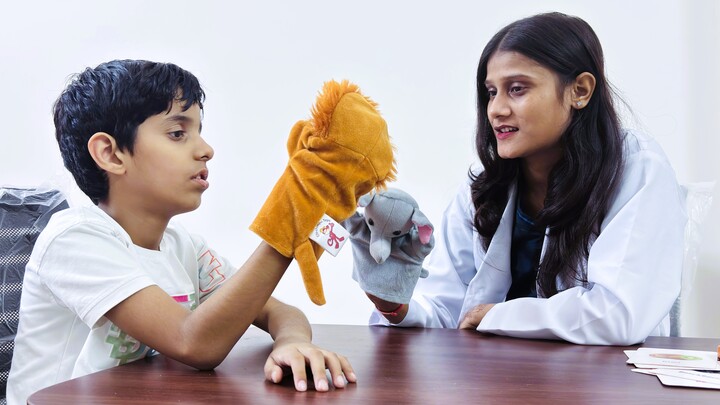
Applied Behaviour Analysis
Individually written, data-tracked programmes for functional communication, daily living skills, compliance with routines and reduction of behaviours that block learning. Useful well beyond autism. More under ABA therapy.
CBT, behaviour support and remedial teaching
Structured cognitive behavioural work for anxiety, anger and emotional regulation in older children, plus multisensory remedial teaching for dyslexia and school liaison. See CBT therapy for the approach used.
Signs it is worth having your child assessed
No babble, pointing or waving at twelve months
Pre-verbal communication comes before words. Its absence is the earliest signal that is easy to act on.
Under twenty words at two years
Especially when the child is not yet putting two words together, such as “more juice” or “papa gone”.
Strangers cannot follow what your child says
By three, most of a child’s speech should be intelligible outside the family. Persistent unclear speech points to a sound system problem.
Repeats, blocks or strains to get words out
Stuck sounds, repeated syllables, visible tension in the face, or avoiding words entirely.
Does not turn when called by name
Especially alongside fleeting eye contact and limited social smiling, when hearing has already been checked.
Cannot follow simple instructions
Understanding difficulties are quiet. The child is often labelled inattentive or stubborn rather than assessed.
| Age | Typically expected | Assess if |
|---|---|---|
| 12 months | Babbles with varied sounds, points, waves, turns to their name, one or two real words | No babble, no gestures, no response to name |
| 18 months | Roughly 10–20 words, follows a one-step instruction, copies sounds and actions | Under five words, or no imitation at all |
| 2 years | Around 50 words, joins two words, identifies body parts and familiar objects | Under twenty words, or no two-word combinations |
| 3 years | Three to four word sentences, mostly intelligible to strangers, asks what and where | Family has to translate for other people |
| 4 years | Tells a short event in order, most sounds correct, holds a back-and-forth exchange | Ongoing sound errors, dysfluency, very short sentences |
| 5 years | Clear connected speech, adult-like grammar, explains and narrates | Any remaining unclear speech, stammering or word-finding difficulty |
About Dr. Manish Sinha
Clinical background
Dr. Manish Sinha is a speech-language pathologist registered with the Rehabilitation Council of India and a member of the Indian Speech and Hearing Association. He is the founder and clinical director of Child Development Centre and practises from Pari Chowk, Greater Noida. His caseload over two decades has run from straightforward articulation work in four-year-olds through to childhood apraxia of speech, minimally verbal autistic children, fluency work with adolescents, and communication programmes for children with Down syndrome and cerebral palsy, and he carries out the assessment and writes the therapy plan himself for every child taken on.
Areas of clinical focus
- Speech delay
- Late talkers
- Expressive language
- Receptive language
- Articulation
- Phonological disorder
- Childhood apraxia
- Stammering
- Autism spectrum disorder
- ADHD
- Down syndrome
- Cerebral palsy
- Sensory processing
- Dyslexia
- Early intervention
- Parent coaching
Registration and professional standing
-
Statutory
Rehabilitation Council of India registration
Practising speech-language pathology in India without RCI registration is not lawful. It is the single credential parents should verify before starting anywhere.
-
Member
Indian Speech and Hearing Association
National professional body for speech and hearing specialists, with continuing education requirements and a code of clinical conduct.
-
20+ yrs
Paediatric clinical experience
Built across institutional and private practice in Delhi NCR before establishing the Greater Noida clinic.
-
Tools
Standardised assessment training
ADOS-2, VB-MAPP, ABLLS-R, CELF, PLS and Sensory Profile used to set baselines and to re-measure at review points.
Conditions seen at the Greater Noida clinic
Speech delay and late talking
Few or no words at an age when peers are talking, often with good understanding underneath. Therapy targets sound repertoire, word learning and early word combinations.
Expressive and receptive language disorder
Short or ungrammatical sentences, difficulty retrieving words, or difficulty holding on to spoken instructions. Both sides are measured separately and treated separately.
Articulation and phonological disorder
Sounds substituted, dropped or distorted past the age they should be mastered, leaving speech hard for people outside the family to decode.
Childhood apraxia of speech
The child knows the word but cannot reliably assemble the movements for it. Needs high-frequency, cue-heavy, repetitive motor practice rather than general language work.
Stammering and stuttering
Repetitions, blocks and physical tension, often with growing avoidance. Therapy combines fluency technique with desensitisation and confidence in real speaking situations.
Autism spectrum disorder
Reduced response to name, limited joint attention, repetitive play and delayed or unusual speech. Assessment is structured; intervention starts with functional communication.
ADHD and attention difficulty
Short attention, impulsivity and disorganisation that undermine classroom learning and friendships. Behavioural programmes are paired with parent and teacher strategies.
Sensory processing difficulty
Distress at noise, touch or movement, or constant seeking of intense input. Sensory work usually has to precede speech goals for these children to be available for learning.
Global developmental delay
Delay across speech, motor, play and social domains. Early structured intervention across all domains matters most in the first three years.
Down syndrome
Speech clarity, oral-motor strength, vocabulary growth and functional communication, coordinated with occupational and physiotherapy input.
Cerebral palsy
Motor speech clarity, feeding and swallowing safety, and alternative communication where speech is not a reliable route.
Dyslexia and learning difficulty
Reading accuracy, phonological awareness and written expression addressed through multisensory remedial teaching, with school coordination.
How the first few weeks go
-
Tell us what you are noticing
Call or message 9958595609 and describe your child’s age and what worries you. If an assessment is not needed, you will be told that. If it is, a slot is usually available within the week.
-
The assessment appointment
Sixty to ninety minutes with Dr. Manish Sinha, covering developmental history, speech sounds, understanding, expression, play, attention and sensory responses using standardised tools. Findings are explained before you leave.
-
A written plan with real numbers
You receive the assessment findings, the goals therapy will target, how often sessions will run, which other therapies are recommended, and what to practise at home. Fees are confirmed at this point.
-
Therapy, data, review
Sessions run with a consistent therapist. Scores are recorded every session and plotted. Goals are formally reviewed on a fixed schedule and the plan is rewritten when the data says it should be.
Speech therapy centre advantages
-
Comprehensive therapy services
The speech therapy centre offers speech, occupational, behavioural (ABA), autism and special education therapies. It also provides hearing aid support to ensure well-rounded care, addressing varied developmental needs for children with diverse challenges.
-
Individualised programmes tailored to each child
Every child has unique developmental needs, and the centre creates customised programmes accordingly. These tailored interventions enhance progress, ensuring effective support for growth, learning and long-term development across different functional skill areas.
-
Experienced and qualified professionals
A skilled team of certified therapists and educators delivers consistent, high-quality care. Their experience supports each child’s progress, fostering development with evidence-based strategies in a compassionate and goal-oriented therapeutic setting.
-
Inclusive and supportive environment
The centre provides a safe, nurturing space where every child feels valued and accepted. This inclusive setting helps build confidence, promotes social connections, and encourages emotional and functional development through daily therapeutic engagement.
Visiting the clinic at Pari Chowk
Address and contact
Dr. Manish Sinha, Speech-Language PathologistA-356, Omaxe NRI City, Pari Chowk
Greater Noida, Uttar Pradesh 201315
Phone: 9958595609
WhatsApp: 9958595609
Clinic website: childdevelopmentcentre.in
Consulting hours
- Monday to Friday9:00 am – 7:00 pm
- Saturday9:00 am – 5:00 pm
- SundayBy appointment
On-site parking. Calls and WhatsApp messages are answered outside consulting hours.
Families travel in from Alpha 1 and 2, Beta 1 and 2, Gamma 1 and 2, Delta, Sigma, Knowledge Park, Jaypee Greens, Sector Chi and Mu, Omaxe NRI City, Greater Noida West, Noida Extension, Gaur City, Bisrakh, Surajpur, Dadri, Noida, Ghaziabad and across Delhi NCR.
Questions parents ask before booking
What happens during the first speech and language assessment?
The appointment runs roughly sixty to ninety minutes. Dr. Manish Sinha takes a developmental history, watches your child play, samples speech sounds and language, checks understanding of instructions, and screens attention and sensory responses.
Standardised tools are used so the starting point is measured rather than estimated, and the findings are explained to you the same day.
How many sessions a week will my child need?
Most children start with two sessions a week. Mild articulation work may need only one; childhood apraxia and autism-related communication goals often need three or more early on. Frequency is set after the assessment and stepped down as goals are met.
My child hears Hindi and English at home. Is that causing the delay?
No. Growing up with two languages does not cause a speech or language disorder, and dropping one language rarely helps. Mixing words early on is normal. If a genuine delay is present it shows in both languages, which is precisely what the assessment checks.
Do you see school-age children and teenagers, or only toddlers?
Both. Toddlers and pre-schoolers are the largest group, but school-age children are seen for leftover speech sound errors, stammering, reading and language difficulty and social communication. Teenagers are seen for fluency, voice and communication confidence.
What is the difference between speech therapy and occupational therapy?
Speech therapy targets communication: sounds, understanding, sentences, fluency and the social use of language. Occupational therapy targets the skills behind daily functioning, including sensory processing, coordination, handwriting, dressing and feeding.
Many children need both, and here the two plans are written together rather than in isolation.
Is stammering treated in older children and adults?
Yes. Fluency therapy runs from pre-school age upward, including adolescents and adults, combining rate and breath control techniques with desensitisation to feared words and situations, and practice in real settings such as classroom answering and phone calls.
How will I know whether therapy is actually working?
Every goal is written so it can be counted: intelligible word count, percentage accuracy on a target sound, sentence length, spontaneous requests per session. Data is recorded each session and plotted, and you receive a written review at set intervals. If the graph is flat, the plan changes.
Which areas do families travel from?
Alpha, Beta, Gamma, Delta and Sigma sectors, Knowledge Park, Jaypee Greens, Sector Chi and Mu, Omaxe NRI City, Greater Noida West and Noida Extension, Gaur City, Bisrakh, Surajpur, Dadri, Noida, and parts of Ghaziabad and Delhi. The clinic is close to the Noida–Greater Noida Expressway with on-site parking.
What should I bring to the first appointment?
Earlier reports, hearing test results, school observations and any paediatrician notes, plus your child’s development record if you keep one. A short home video of your child talking is genuinely useful, since many children speak far less in an unfamiliar room.
Do I need a paediatrician’s referral first?
No. Parents book directly. Where a medical review is needed, such as a hearing evaluation or a neurology opinion, that is recommended in writing after the assessment.
Can I sit inside the therapy room?
Yes, and it is encouraged early on so you can learn the techniques being used. Some children settle faster without a parent present; in those cases you are briefed at the end of each session and shown exactly what to practise that week.
If something about your child’s speech is worrying you, get it measured
An assessment costs you an hour and gives you an answer. Waiting costs developmental time that is harder to recover later.